
KNX Architecture – Integrated Building Automation System
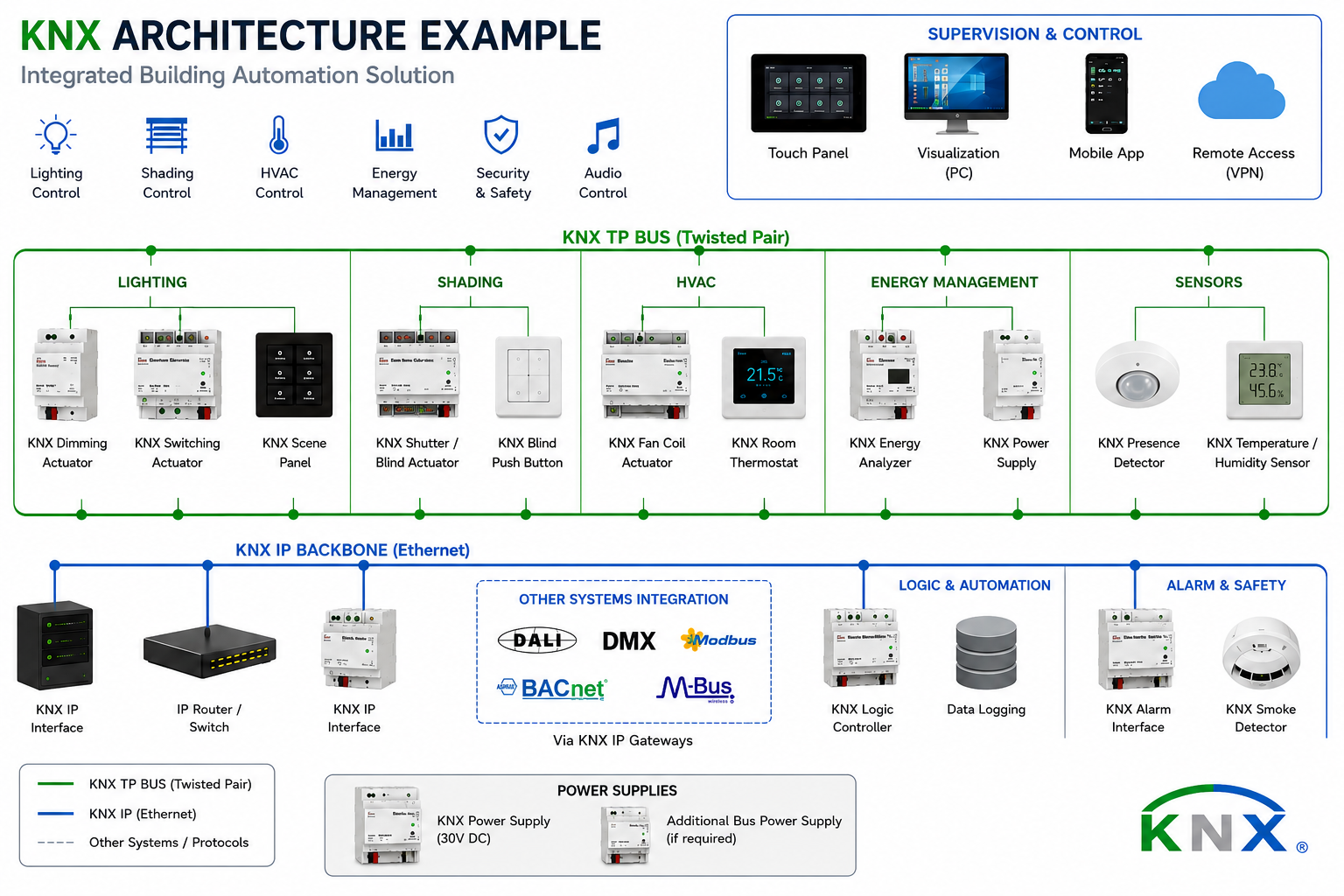
This diagram illustrates a typical KNX-based integrated building automation architecture, demonstrating how multiple building functions can operate on a common, decentralized control infrastructure.
At the field level, the KNX TP (Twisted Pair) bus provides communication and power for KNX devices distributed throughout the building. Lighting actuators, switching actuators, scene controls, shading equipment, HVAC controllers, thermostats, energy-management devices, presence detectors, and environmental sensors communicate using the same standardized KNX protocol.
The system is not dependent on a single central controller for normal building operation. Individual KNX devices contain their own application logic and can exchange commands, status information, measured values, alarms, and operating parameters directly across the KNX bus.
For larger installations, a KNX IP backbone based on Ethernet can provide higher-speed communication between KNX lines, areas, system interfaces, supervisory equipment, and other building systems. KNX IP routers and interfaces provide the connection between the Ethernet infrastructure and individual KNX TP networks.
KNX can also serve as an integration platform for other building technologies. Through appropriate gateways and interfaces, systems using DALI, DMX, Modbus, BACnet, M-Bus and other protocols can exchange information with the KNX installation. This allows lighting, HVAC, energy metering, architectural lighting, and other subsystems to participate in coordinated building-wide automation.
Supervisory and visualization systems can provide touch-panel operation, PC visualization, mobile applications, monitoring, data logging and authorized remote access without replacing the distributed intelligence of the KNX field devices.
The architecture demonstrates one of the principal engineering advantages of KNX: multiple building disciplines can be integrated through an open, manufacturer-independent automation standard while maintaining distributed control at the field level and scalable IP-based communication for larger installations.