
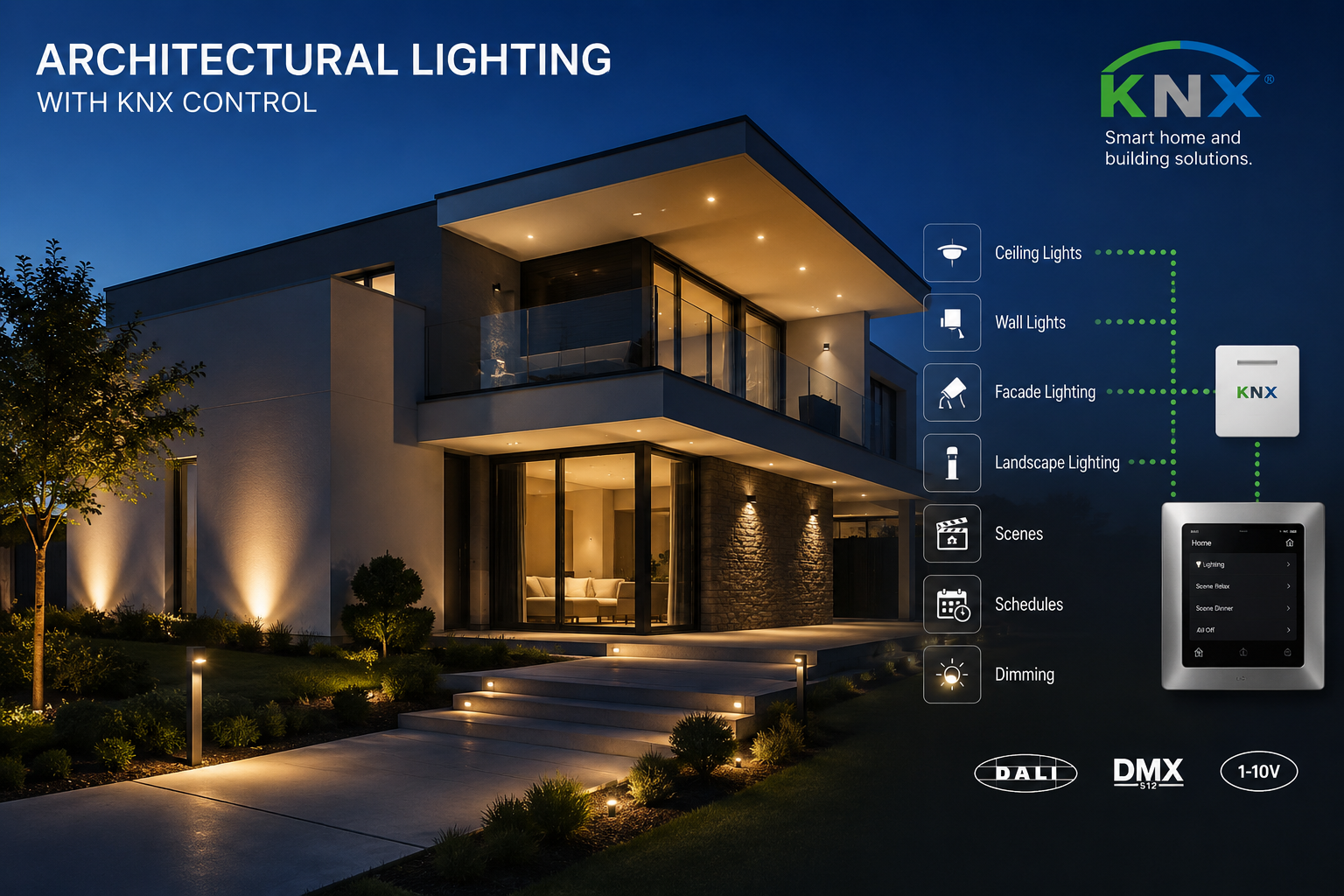
Architectural Lighting with KNX Control
This concept illustrates a fully integrated architectural lighting system based on the KNX open building automation standard. KNX provides the control and automation infrastructure, allowing interior, exterior, façade, and landscape lighting to operate as one coordinated building system.
The KNX system can control switching, dimming, lighting scenes, schedules, occupancy-based operation, daylight response, and centralized or local user control. Depending on the luminaire and project requirements, KNX can interface with DALI/DALI-2, DMX, 0–10 V / 1–10 V, phase-cut dimming, and relay-controlled lighting through appropriate KNX actuators and gateways.
Lighting functions can include:
- Interior architectural lighting — recessed, linear, accent, decorative, and indirect lighting.
- Façade and exterior lighting — coordinated architectural illumination and automatic dusk-to-dawn operation.
- Landscape lighting — pathways, trees, architectural features, and outdoor living areas.
- Scene control — predefined settings such as Welcome, Entertain, Dinner, Evening, Night, and All Off.
- Human Centric Lighting (HCL) — tunable-white lighting with adjustable intensity and correlated color temperature when supported by the lighting system.
- Automatic control — schedules, occupancy sensors, daylight sensors, astronomical clock functions, and other building conditions.
- Visualization and user interfaces — wall-mounted touch panels, mobile interfaces, and centralized building visualization.
Because KNX is a distributed automation platform, lighting control does not have to depend on a single proprietary central processor. Sensors, switches, actuators, gateways, and visualization devices communicate over the KNX infrastructure and can be selected from multiple KNX manufacturers.
For architectural projects, this provides a scalable control platform capable of integrating sophisticated lighting design with shading, HVAC, energy management, occupancy detection, and other building systems while maintaining a common automation infrastructure.